Sunday, August 31, 2025

How to access BBC Sounds outside the UK

Looking to access BBC Sounds – the BBC's podcast, radio and music app – from outside the UK? If you're visiting the US, Canada, Australia or indeed anywhere else, you can use a VPNNordVPN works best – to unblock BBC Sounds and listen as normal.

We'll go into detail below and explain why the BBC's recent announcement that it would block international access to the BBC Sounds app saddened (and angered) many listeners around the world.

Here's a full (and quick) guide to how to get BBC Sounds from abroad...

When did the international BBC Sounds block come into force?

International access to BBC Sounds was shut down on Monday, July 21.

Can I still access BBC Sounds from abroad or on holiday? 

Yes. UK residents will be able to continue accessing the BBC Sounds app from abroad with a VPN. We recommend Nord, which comes with a 30-day trial and over 70% off when you use our deal below...

How to unblock BBC Sounds with a VPN

If you're outside the UK at the moment and blocked from using BBC Sounds, you can still access the app thanks to the wonders of a VPN (Virtual Private Network).

The software allows your devices to appear as if they're back in your home country regardless of where in the world you are. So ideal for listeners away for work or on vacation wanting a taste of home.

NordVPN is our favorite:

Editors Choice

NordVPN – get the world's best VPN
We regularly review all the biggest and best VPN providers and NordVPN is our #1 choice. It unblocked every streaming service in testing and it's very straightforward to use. Speed, security and 24/7 support available if you need – it's got it all.

The best value plan is the two-year deal, which sets the price at $3.39 per month and includes an extra 3 months absolutely FREE. There's also an all-important 30-day no-quibble refund if you decide it's not for you.

- So, try NordVPN 100% risk-free for 30 daysVIEW DEAL ON

Is there a BBC Sounds alternative?

Listeners based outside the UK can now access a limited selection of BBC audio programming via the BBC.com website and the BBC app (iOS / Android).

To put it mildly, however, they're nothing at all like BBC Sounds!

The only live services available through BBC.com and the BBC app are BBC Radio 4 and the BBC World Service English. They also host select podcasts, and news and history programming, such as Global News Podcast, You're Dead to Me and Infinite Monkey Cage.

Although you can listen via BBC.com and the BBC app without an account, you have to sign in on order to download, follow and save shows.

Can I listen to BBC 6 Music and other radio stations from outside the UK?

All, however, is not yet lost. You can still listen to BBC Radio stations from outside the UK by visiting their individual websites directly, through a web browser (links listed below).

It's a crude workaround, but it works.

However, these websites don't support key BBC Sounds features, such as the option to set a radio station as your alarm or even the ability to view a station's schedule.

Furthermore, only select radio content will be made available on-demand through the websites.

BBC Radio 1

BBC 1Xtra

BBC Radio 2

BBC Radio 3

BBC Radio 4 Extra

BBC Radio 5 Live

BBC Asian Network

BBC 6 Music

Click for more BBC Radio stations▼

BBC Live News

BBC Radio Scotland

BBC Radio Scotland Extra

BBC Radio Orkney

BBC Radio Shetland

BBC Radio nan Gaidheal

BBC Radio Ulster

BBC Radio Foyle

BBC Radio Wales

BBC Radio Wales Extra

BBC Radio Cymru

BBC Radio Cymru 2

Local radio

BBC Radio Berkshire

BBC Radio Bristol

BBC Radio Cambridgeshire

BBC Radio Cornwall

BBC CWR

BBC Radio Cumbria

BBC Radio Derby

BBC Radio Devon

BBC Essex

BBC Radio Gloucestershire

BBC Radio Guernsey

BBC Hereford & Worcester

BBC Radio Humberside

BBC Radio Jersey

BBC Radio Kent

BBC Radio Lancashire

BBC Radio Leeds

BBC Radio Leicester

BBC Radio Lincolnshire

BBC Radio London

BBC Radio Manchester

BBC Radio Merseyside

BBC Radio Newcastle

BBC Radio Norfolk

BBC Radio Northampton

BBC Radio Nottingham

BBC Radio Oxford

BBC Radio Sheffield

BBC Radio Shropshire

BBC Radio Solent

BBC Radio Solent Dorset

BBC Radio Somerset

BBC Radio Stoke

BBC Radio Suffolk

BBC Radio Surrey

BBC Radio Sussex

BBC Radio Tees

BBC Three Counties Radio

BBC Radio Wiltshire

BBC Radio WM

BBC Radio York

Further BBC Sounds troubleshooting tips

If you still can't access BBC Sounds, even with the aid of a VPN, there are a few more things you can try.

Make sure your BBC account is associated with a valid UK post code, such as W1A 1AA.

The BBC Sounds app (iOS / Android) won't appear in the Play Store or the App Store outside the UK, but you may be able to get around that by changing your phone's region in the settings menu.

The BBC, like most broadcasters and networks, is engaged in a neverending cat-and-mouse battle with VPN providers.

Although we've ranked the best iPlayer VPNs, something we've worked out through thorough testing, if one of them works today there's no guarantee the same will be true tomorrow, in which case you can raise the issue with your VPN provider's customer support team, and ask them to recommend the best server to connect to.

Why did BBC Sounds get blocked? What's the full story?

So what would compel the corporation to cut one of its most popular and beloved exports? The decision was taken without a consultation, and BBC management has rebuffed calls for an explanation to be provided.

For weeks following the announcement, Andrea Catherwood, the presenter of the BBC Radio 4 podcast Feedback, endeavoured to get a BBC spokesperson onto her show in order to justify the move, without success.

The move has been met with widespread anger and sadness, but above all disbelief. BBC Sounds doesn't just provide a connection to home for Brits living abroad, it's an invaluable purveyor of culture, education and entertainment, which has served as a key platform for musicians, artists and performers, some of whom owe their entire careers to radio.

BBC Sounds' demise has also caused a political storm in Ireland, where listeners north of the border retain full access to the app.

The memorandum of understanding agreed by the UK and Irish governments in 2010 stressed the importance of public service broadcasting on both sides of the border, for "promoting cultural diversity, in providing educational programming, in objectively informing public opinion, in guaranteeing pluralism."

The subject at the time was Irish-language channel TG4, with the MoU advocating its availability in Northern Ireland as well as the Republic of Ireland. However, listeners in the Republic of Ireland have now had their access to BBC Sounds blocked.

We test and review VPN services in the context of legal recreational uses. For example:1. Accessing a service from another country (subject to the terms and conditions of that service).2. Protecting your online security and strengthening your online privacy when abroad.We do not support or condone the illegal or malicious use of VPN services. Consuming pirated content that is paid-for is neither endorsed nor approved by Future Publishing.


from Latest from TechRadar US in News,opinion https://ift.tt/BEV8JLY

Who says databases are boring? Microsoft, Google, and AWS all back the Linux Foundation's move to add DocumentDB

  • DocumentDB started as a Postgres add-on before evolving into a standalone project
  • The Linux Foundation’s adoption signals a new era for open document databases
  • MongoDB’s restrictive licensing decisions created openings for DocumentDB’s permissive approach

For years, open source databases have been described as either traditional relational systems or newer NoSQL alternatives.

The emergence of DocumentDB, first introduced by Microsoft and now adopted under the Linux Foundation, is blurring that divide.

By combining PostgreSQL with document-oriented storage through extensions, DocumentDB positions itself as both familiar to developers and disruptive to existing NoSQL players.

From PostgreSQL extensions to a full project

Its adoption under the permissive MIT license signals a push for wider community participation.

"It's great that Microsoft, AWS, and others are joining forces to work on DocumentDB, an open source implementation of a MongoDB-compatible API on top of PostgreSQL,” said Bruce Momjian, founding member of the PostgreSQL core development team.

"We built DocumentDB with a simple goal: give developers an open document database with the flexibility of NoSQL and the power, reliability, openness, and ecosystem of Postgres," said Kirill Gavrylyuk, vice president at Microsoft.

DocumentDB began in 2024 as a pair of PostgreSQL add-ons for handling BSON data models and document queries.

Within a year, the project expanded into a standalone database that still depends heavily on PostgreSQL’s reliability and ecosystem.

This dual identity, part relational engine and part document store, makes DocumentDB attractive for developers seeking a common interface.

Yet skeptics point out that layering document features onto PostgreSQL does not erase the structural limitations of relational systems.

The move to bring DocumentDB into the Linux Foundation has attracted support from Amazon Web Services, Google, and others.

Their endorsement signals a rare moment of alignment among major cloud vendors, particularly given the licensing disputes that fractured the database world in recent years.

"AWS is excited to contribute to the open source DocumentDB project, now stewarded by the Linux Foundation," said Adam Abrevaya, director, Amazon DocumentDB.

"It is great to see the DocumentDB project joining the Linux Foundation, which assures customers and the community have an openly governed, open source option available to them," said Sailesh Krishnamurthy, vice president of engineering, Google Cloud.

Still, critics recall that vendor neutrality has often been more symbolic than practical.

A project backed by hyperscalers can easily become shaped by their priorities, leaving smaller contributors to wonder how much influence community governance will genuinely hold.

The adoption of DocumentDB can also be seen as a response to MongoDB’s decision to embrace restrictive licensing models.

By offering a permissive alternative, the Linux Foundation hopes to push toward a more interoperable standard for document databases.

Industry veterans argue that such a standard is long overdue, but the timing is contentious.

However, MongoDB continues to dominate the market, and its defenders insist that bolting document capabilities onto PostgreSQL is no substitute for a native design.

"DocumentDB fills a critical gap in the document database ecosystem, attracting contributors, users, and champions. It provides an open standard for document-based applications," said Jim Zemlin, executive director of the Linux Foundation.

For developers working on Linux distros or configuring laptops for programming, DocumentDB may appear as another tool promising simplicity and openness.

Enterprises considering mobile workstations or SaaS integrations may also see appeal in a standardized, Postgres-based NoSQL option.

Yet the reality is less straightforward because success depends on technical merit and the community's resistance to tilting toward the largest vendors.

You might also like


from Latest from TechRadar US in News,opinion https://ift.tt/QtjIr09

Who says crime doesn't pay? Microsoft has deployed its own security chip on all Azure servers to protect its customers from $10 trillion cybercrime 'pandemic'

  • Microsoft has revealed how it protects Azure with an Integrated HSM chip
  • Azure security stack includes Azure Boost, Hydra BMC and Caliptra 2.0
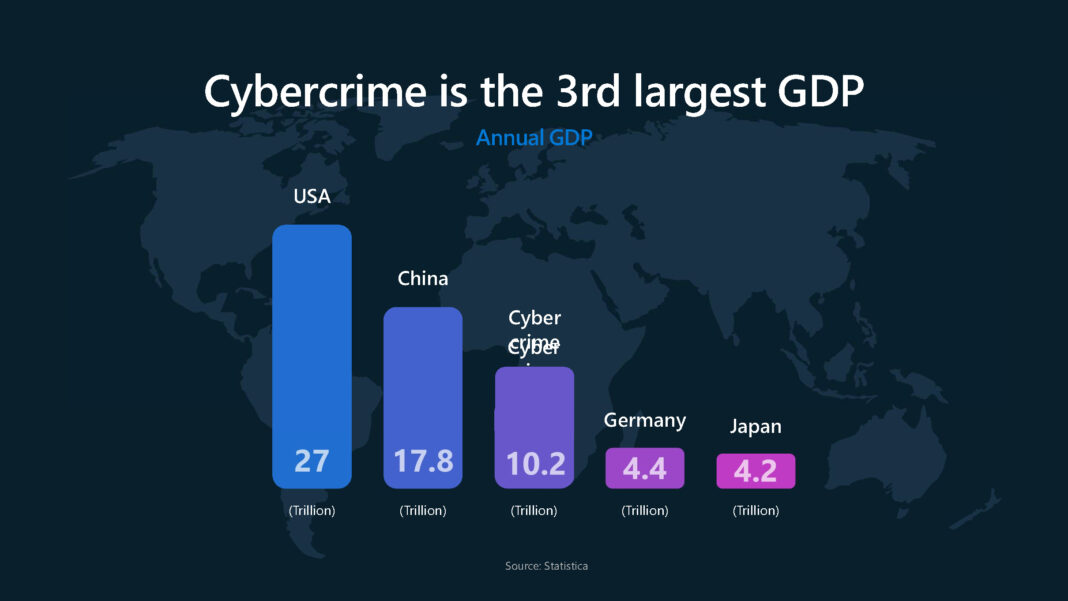
  • Cybercrime reportedly worth $10.2 trillion annually, making it the world’s third-largest economy in 2025

Microsoft has revealed more on the custom-built security chip it deploys across every Azure server, aiming to counter what it calls a cybercrime “pandemic” now costing $10 trillion annually.

The Azure Integrated HSM, which was first announced in late 2024, is the centerpiece of a wider security architecture the company outlined at the recent Hot Chips 2025 event.

A slide Microsoft showed there claims the global cost of cybercrime is currently $10.2 trillion - meaning it now ranks as the equivalent of the third-largest economy in the world.

Cybercrime is third largest GDP

(Image credit: Microsoft)

Azure security measures

The trillion-dollar estimate places cybercrime behind the United States and China, but ahead of Germany and Japan, and also far bigger than the entire AI market.

Microsoft said the scale of the threat requires both architectural and operational changes.

As ServeTheHome reports, the company listed a number of statistics at the event, including that Azure already spans more than 70 regions and 400 data centers, supported by 275,000 miles of fiber and 190 network points of presence, along with employing 34,000 engineers dedicated to security.

To take on the cybersecurity problem at a hardware level, Microsoft moved from a centralized hardware security module model to its own Azure Integrated HSM.

The custom ASIC is designed to meet FIPS 140-3 Level 3 requirements, providing tamper resistance and local key protection within servers.

By embedding the chip in each system, cryptographic functions no longer need to pass through a centralized cluster, reducing latency while enabling tasks such as AES, PKE and intrusion detection locally.

ServeTheHome noted building an in-house chip required trade-offs. Instead of scaling hardware security modules at a cluster level, Microsoft had to size them for individual servers.

The result, the company argued, was a balance between performance, efficiency and resilience.

The tech giant also presented its “Secure by Design” architecture at Hot Chips, part of its Secure Future Initiative.

This includes Azure Boost, which offloads control plane services to a dedicated controller and isolates them from customer workloads, and the Datacenter Secure Control Module, which integrates Hydra BMC, and enforces a silicon root of trust on management interfaces.

Confidential computing, backed by trusted execution environments, extends protection to workloads in multi-tenant environments.

Caliptra 2.0, developed in collaboration with AMD, Google and Nvidia, anchors security in silicon and now incorporates post-quantum cryptography through the Adams Bridge project.

Microsoft Secure by Design

(Image credit: Microsoft)

You might also like


from Latest from TechRadar US in News,opinion https://ift.tt/JmWfius

Everyone is writing off the new wave of high-performance Chinese EVs – here's why that's a big mistake

It feels like only yesterday that the internet was abuzz with the news that Xiaomi – best known for its smartphones, watches and wearables – smashed the electric production car record at Germany’s infamous Nurburgring.

The SU7 Ultra beat the formidable Porsche Taycan Turbo GT and the $2.5m Rimac Nevera, as well as shaming the Tesla Model S Plaid, itself a car that embarrassed many dedicated performance brands when it set a blistering time back in 2021.

Now Yangwang has performed a similar feat, breaking an EV top speed record by hitting an eye-watering 293.54mph at the ATP test track in Germany.

It beat previous records held by the Aspark Owl and the Rimac Nevera. Yup, another blow to the brand whose CEO is now head honcho at Bugatti.

The fact that the Xiaomi SU7 bettered a Porsche Taycan Turbo GT on its very first lap around the Nurburgring is mildly embarrassing

The Yangwang U9, which is just one model from the high-performance sub brand of BYD, is particularly impressive given its ground-breaking electric powertrain. The Track Edition that set the record features four motors, each of which develops a staggering 744bhp.

Total output tickles almost 3,000bhp, while the clever torque vectoring system ensures the majority of this grunt can be delivered to the road by monitoring and adjusting torque to each wheel more than 100 times a second.

There’s also a DiSus-X Intelligent Body Control System, which automatically adjusts the suspension system for maximum grip and reduction of pitch and roll. The same tech enables the standard road-going car to leap over potholes.

Yangwang U9 Track Edition

(Image credit: Yangwang/BYD)

What’s more, Yangwang says it is pioneering a 1200V ultra-high-voltage vehicle platform in this car, one that has been optimized to handle the sort of extreme battery discharge scenarios experienced during a high-speed record attempt.

China clearly has a stranglehold on battery technology and is currently leagues ahead of western automakers in both the chemistry and production capabilities

Right now, an 800V system is considered cutting-edge and is enough to see batteries brimmed in under five minutes from the most powerful charging stations. Yangwang didn’t go into any details, but we expect this U9 Track Edition can slurp juice from a MegaWatt charging station at astonishing rates.

There is also no word on what the bespoke Track Edition would cost a private buyer, but the ‘standard car’, complete with some 1,300bhp, went on sale in 2024 priced at 1.68 million Yuan (or around $236,000 / £193,000 / AU$400,000).

To put that into perspective, that is more than the current Ferrari F80, which cost almost $4 million if you were lucky enough to get invited to buy one.

Shifting perceptions

Porsche Mission X Concept

(Image credit: Porsche)

Despite the impressive feats demonstrated by both Xiaomi and Yangwang, the general sentiment among US and European performance car enthusiasts is that the threat is largely overhyped, that it’s "easy to make electric cars go fast in a straight line" or that nobody is going to spend their hard-earned cash on something badged Yangwang.

While it is true that brand value remains arguably one of the most important factors when it comes to the world of luxury and performance cars (Ferrari’s profits hit $2.67 billion last year), the age of electrification is changing all of that and the Italian marque might not experience the same success when it launches its debut EV this year.

I lost count of the number of times the phrase 'Temu Ferrari' was banded around the comments sections

Porsche said this week that it has scrapped its Cellforce high-performance battery division, which was set up to produce the sort of next-generation cells that would power upcoming electric hyper cars, such as the previously-teased Mission X concept.

The German sports car-maker said that a "global lack of volumes" means that it is not financially viable to proceed with its plans to develop its own batteries. It has also slowed its transition to purely electric vehicles, as customer demand has been relatively weak.

Performance that doesn't cost the earth

XiaomiSU7Ultra

(Image credit: Xiaomi)

China clearly has a stranglehold on battery technology and is currently leagues ahead of western automakers in both the chemistry and production capabilities, but it is also proving that it now has the technical knowhow to produce brutally capable electric performance cars.

The fact that the Xiaomi SU7 bettered a Porsche Taycan Turbo GT on its very first lap around the Nurburgring is mildly embarrassing, especially for a brand that has been building and racing cars for over 75 years.

Chinese brands are already busy making the electric vehicle more affordable for the masses, but it is also on a mission to democratize performance

Similarly, Yangwang looks like it has the technological prowess to produce a version of the U9 that could crack the 300mph max speed barrier – something that was achieved by the physics-defying, $4million+ Bugatti Chiron Super Sport just last year.

Put simply, China is busy smashing electric vehicle records and many are still adamant that the brands are somehow substandard or cheaper replicas. I lost count of the number of times the phrase 'Temu Ferrari' was banded around the comments sections of various news coverage.

Chinese brands are already busy making the electric vehicle more affordable for the masses, but it is also on a mission to democratize performance. A fact that has many of the most revered brands heading back to the drawing board.

In China, both the Yangwang U9 and Xiaomi SU7 have proven to be huge sales successes for the two brands, as the domestic market naturally pivots towards the latest technological advances.

It's still yet to be seen whether the rest of the world even wants high performance EVs of this nature – but if it does, China will be there to offer them at a fraction of the price.

You might also like


from Latest from TechRadar US in News,opinion https://ift.tt/LF9YXK8

Want to stick with Windows 10 after October 2025? Here are your options – including how to get a free year of extra support

It probably hasn't escaped your attention that Windows 10 support expires on October 14, 2025. Given that, there's precious little time left before those who remain on the operating system without taking any action will be left with no security updates. Those patches are vital protection for your system, and without them, an unsupported version of Windows is open to new vulnerabilities and potentially being compromised.

If you want to stick with Windows 10 – maybe you dislike Windows 11, or your PC is unable to run it – then there are actually a few options for getting additional support for an extra year. This will carry you through to October 2026, giving you more breathing room to decide on the next step for your Windows 10 PC.

These options can be accessed via the Extended Security Updates (ESU) program that Microsoft revealed late last year, which is being offered to consumers for the first time. (Previously, this scheme was for businesses only.)

You'll have three choices – one of which is completely free, though it has a small catch – so let's go over those next before addressing the issue of how you actually sign up for the ESU scheme (which is causing confusion for some people).

Windows 10 Logo on Laptop

(Image credit: Shutterstock - Wachiwit)

ESU Option 1: Free updates via syncing PC settings

This is the route I'll be taking, and I imagine it'll be the preferred option for a lot of Windows 10 users. This way, you don't need to pay anything at all for the extra year of support: Microsoft just asks that you sync your PC settings to OneDrive (via the Windows Backup app).

Note that you don't have to back up all your PC's data, only the settings. I've seen some confusion about this online, with people not keen on 'giving Microsoft all their data' - you aren't doing this, rest assured. You do have to share your PC settings, though, and you will, of course, need to be signed up for a Microsoft account.

ESU Option 2: Use Microsoft Rewards

If you've accumulated Microsoft Rewards points, which are accrued by using Bing or other Microsoft services, or spending at the Microsoft Store, you can use these to pay for the ESU scheme. It'll cost you 1,000 Microsoft Rewards points.

ESU Option 3: Pay $30

If you don't have Microsoft Rewards points and absolutely refuse to sync anything with Microsoft, then the only remaining option is to pay for the extra year of extended support. It'll cost $30 or the equivalent in your local currency. Note that even if you pay for extended support, you'll still need a Microsoft account.

A man at a desk using a laptop and holding his hands up, while having a confused look on his face

(Image credit: Shutterstock/fizkes)

I can't see the ESU scheme anywhere - how do I sign up?

You sign up for the ESU program by clicking a link in the Windows Update panel. Just search for 'Windows Update' in the taskbar search box (or Settings), and when you're in the panel, you might see an option to 'Enroll now' for Extended Security Updates on the right-hand side of the screen.

Notice I said that you might see it, because here's the thing: Microsoft has only begun rolling out this option right now. As Microsoft recently clarified, it's a slow-paced rollout, meaning a lot of folks can't see it yet, myself included (at the time of writing). However, rest assured that it's coming; you'll just have to be patient.

Microsoft has promised that the ESU enrollment wizard will appear on all Windows 10 PCs before the support deadline expires in mid-October. So most likely, you'll see it on your PC in September at some point (possibly after that month's update). Just keep checking back in Windows Update and it'll turn up eventually, or it should do, barring any weirdness or bugginess on Microsoft's part (which can't ever be fully ruled out).

Whatever you do - don't do nothing

Make sure you know what you want to do in terms of getting extended updates, and keep checking back to sign up for the ESU program. Whatever you do, don't just stay on Windows 10 after October 2025 with no updates provided, because as time ticks on, you'll increasingly be running a greater risk. The more months that pass by, the more security holes that may be revealed and remain unpatched, possibly opening the door for your Windows 10 PC to be hacked in some way.

If you don't get extended updates for Windows 10 sorted, or don't like any of the options, and don't want to upgrade to Windows 11, then look at moving to another platform. A Windows-like flavor of Linux might be your best bet.

You might also like


from Latest from TechRadar US in News,opinion https://ift.tt/lxGdiBc

Saturday, August 30, 2025

This creative concept reinvents the 1.44MB floppy disk as a modern storage device – a holder for today’s SD cards packing terabytes of storage

  • The iconic floppy disk is reborn as a storage case for today's terabyte-packing SD cards
  • From 1.44MB past to terabyte present, the new design bridges eras creatively
  • Fun artwork references glitch aesthetics and retro computing

Floppy disks are unquestionably a relic from the past, although they still keep resurfacing in unusual places - most recently, surfacing in the American prison service, and an enterprising YouTuber set out to build a floppy disk from scratch.

If you're of a certain age, you'll no doubt still remember the feeling of sliding a floppy disk into a computer, hearing that quiet click, and waiting as files loaded bit by bit. That memory will come rushing back with the Floppy Disk-Inspired SD Card Packaging, a design concept created by Indian industrial designer Ayushmaan Singh Jodha for SanDisk.

It takes the iconic 3.5-inch floppy and reimagines it as a different kind of storage device - as a case for today’s SD cards.

floppy disk concept

(Image credit: Ayushmaan Singh Jodha )

From megabytes to terabytes

Where a floppy once held 1.44MB, this design protects cards that now carry gigabytes or even terabytes.

The idea bridges eras of technology in a fun way, but with a serious practical purpose.

SD cards can easily get lost, slipping out of pockets during a shoot, hiding beneath clutter in a busy studio, or disappearing into the depths of a travel bag. I’ve lost a good number of them over the years.

The floppy case provides a larger, sturdier object to hold onto, making it easier to keep track of the tiny cards that store important work.

The packaging keeps the same square profile and iconic shutter, transforming an obsolete form into a fresh, modern tool.

The design showcases artwork that references early computer culture, glitchy error screens, and retro sci-fi themes. The idea is turn the cases into collectible pieces that creatives may want to keep on display, not tucked away in drawers.

The sliding shutter reveals the hidden compartment where the SD card is stored, adding a small sense of interaction to an otherwise simple task.

Is it truly practical? No, but it’s fun and something I’d love to own.

Via Yanko Design

You might also like


from Latest from TechRadar US in News,opinion https://ift.tt/IcBJonG

Got no signal? This devious cyberattack can downgrade your phone from 5G to 4G without you knowing

  • 5G phones can be silently downgraded to insecure 4G, leaving the device exposed
  • The exploit works without setting up expensive and complex fake towers
  • Tested smartphones include flagship models from Samsung, Google, Huawei, and OnePlus

In late 2023, researchers uncovered a set of flaws in 5G modem firmware from major chipmakers, including MediaTek and Qualcomm, collectively named 5Ghoul.

A group of academics at the Singapore University of Technology and Design (SUTD) has now shown how 5G phones can be tricked into falling back to 4G networks through a method that avoids the need for a fake base station.

Instead, it targets a vulnerable stage of communication between phone and tower, where critical messages remain unencrypted.

How the toolkit works in practice

The SNI5GECT toolkit, short for “Sniffing 5G Inject,” makes use of the tiny time window at the start of a connection attempt.

It targets the pre-authentication phase, when the data passing between the tower and the phone remains unencrypted.

Because of this gap, attackers can intercept and inject messages without needing to know the phone’s private credentials.

During this stage, the system can capture identifiers sent from the tower and use them to read and modify messages.

With such access, the attacker can force a modem crash, map a device fingerprint, or trigger a switch from 5G to 4G.

Since 4G carries long-known flaws, the forced downgrade leaves the target open to older tracking or location attacks.

The tests revealed a success rate between 70% and 90% when attempted from around twenty meters away, suggesting the method works in realistic conditions.

The academics tested the framework on several smartphones, including popular models from Samsung, Google, Huawei, and OnePlus.

In these cases, the researchers were able to intercept both uplink and downlink traffic with notable accuracy.

Importantly, the method avoids the complexity of setting up a rogue base station, something that has long limited practical attacks on mobile networks.

The Global System for Mobile Communications Association (GSMA) has since confirmed the issue and assigned it the identifier CVD-2024-0096, marking it as a downgrade risk.

The claim from the team is that their toolkit is not meant for criminal use but for further research into wireless security.

They argue it could help with the development of packet-level detection and new forms of 5G protection.

Still, the ability to crash devices or silently downgrade them raises questions about the resilience of current networks.

While no clear reports exist of real-world abuse so far, the method is public and the software is open source, so the risk remains that skilled actors could adapt it.

Unfortunately, users have few direct options to block such low-level exploits, though broader digital hygiene may help limit downstream risks.

However, running updated antivirus software, securing credentials with a password manager, and enabling an authenticator app for accounts can reduce the impact of secondary attacks that might follow from a network downgrade.

Via The Hacker News

You might also like


from Latest from TechRadar US in News,opinion https://ift.tt/gzcF5h2

Friday, August 29, 2025

Want to access mature games on Steam? You’ll need a credit card for that – but only in the UK

PC gaming giant Valve has started to bow to the UK’s Online Safety Act by requiring Steam users to verify their age with a credit card in order to access games with mature content.

“In order to access Steam store pages for mature content games as well as their associated community hubs, you need to be logged into an active user account and explicitly opt-in through the account settings page.” Steam’s Support page details. "For UK users, this opt-in process requires age verification. Your UK Steam user account is considered age verified for as long as a valid credit card is stored on the account.”

The Online Safety Act stems from a goal to prevent children from seeing inappropriate, sexual, or generally mature content across a myriad of online platforms and services. As such, users of services and sites that host mature content, even if not exclusively so, need to verify that they are 18 years of age or older.

Often this requires things like a facial scan or credit card details, which privacy-centric people might be concerned about parting with, given verification tools can be delivered via third-party organizations with their own rules on data collection and use. Notably, a credit card is asked for as in the UK you need to be 18 years old to apply for one.

“Having the credit card stored as a payment method acts as an additional deterrent against circumventing age verification by sharing a single Steam user account among multiple persons,” noted Valve.

While I understand the need for such verification, and do hope that it will protect young people from some of the more unsavory content one can find online if so inclined, as a 38-year-old Steam user, it’s a minor annoyance and another hurdle to hop when logging into the gaming platform on different PCs or devices.

It’s also a bit annoying as there are still people who don’t have credit cards; for example, I only got one that I actually use back last year.

Protecting privacy

For people like me who can be a little iffy about handing over credit card details, Valve’s process is to have the credit card stored as a payment method so it won’t be using an off-platform third-party verification service, which should mean your credit card details are kept secure.

“The data processed in the verification process is identical to that of the millions of other Steam users who make purchases or store their payment details for convenience,” said Valve. “The verification process therefore provides no information about a user's content preferences to payment providers or other third parties.”

So this makes me feel a little more comfortable with the whole thing, and should hopefully be a one-and-done process. I’ve become so used to how easy Steam is to use from making secure payment to logging in via the mobile app, so I do hope this adapting to the Online Safety Act won’t erode that feeling of ease.

It’ll be interesting to see if other countries follow the UK’s example or if Valve decides to roll out such verification for all users and a one-stop-shop way to allow ‘safe’ access to mature content. I guess time will tell.

You might also like


from Latest from TechRadar US in News,opinion https://ift.tt/huVtIDT

SK Telecom hit with $97 million fine over massive data leak

  • SK Telecom suffered a data breach that was discovered in April 2025
  • It affected roughly 27 million people
  • The company was fined for it, and will need to make significant changes to its operations

SK Telecom (SKT), one of the biggest telecommunications services providers in South Korea, was fined almost $100 million for failing to protect user data.

In April 2025, the company discovered a malware breach that allowed threat actors to lurk within its systems for years. Some researchers even claim the attack started in August 2021.

The miscreants targeted SKT’s Home Subscriber Server (HSS) and other critical infrastructure, exposing sensitive subscriber data, including USIM authentication keys (KI), International Mobile Subscriber Identity (IMSI) numbers, IMEI device identifiers, phone numbers, email addresses, and possibly other personal data.

"Very weak condition"

Approximately 27 million people were affected by the breach.

Now, Reuters reports that the government-run Personal Information Protection Commission issued a statement, confirming the fine of about 134 billion won ($96.53 million) for “neglecting its duty to take safety measures” and for “delays in notifying the leak to customers”.

The statement also claims SKT’s systems were in a “very weak condition” which allowed threat actors to access the company’s intranet. There were no passwords, or other safety measures, defending the servers from outside influence, and operating systems were outdated and running without the latest security patches.

Besides being forced to pay the fine, the company will also have to “strengthen safety rules on information protection” and revamp its governance.

Responding to a Reuters inquiry, SK Telecom said it “felt a grave responsibility” and will make protecting customer information a “top priority”.

In response, it launched an “Information Security Innovation Plan”, that includes implementing zero-trust architecture, expanding encryption, forming a red team, elevating the CISO role to report directly to the CEO, and adding cybersecurity experts to the board.

Customers received free USIM card replacements, and were offered 50% off August subscription fees. Furthermore, whoever wanted to cancel their contract prematurely was allowed to do so without extra fees.

Via Reuters

You might also like


from Latest from TechRadar US in News,opinion https://ift.tt/q5kmxB2

Thursday, August 28, 2025

US warns Chinese tech firms may have ties to notorious cyber espionage group which hit hundreds of firms

  • Security agencies issue joint statement warning Chinese tech firms may be indirectly collaborating with Salt Typhoon
  • Salt Typhoon is a hacking group behind multiple high-profile attacks
  • Group is thought to have serious links to Chinese government

A new joint cybersecurity advisory from the National Security Agency (NSA) and other agencies like CISA, the UK’s NCSC, Canada’s CSIS, Japan’s NPA and many more looks ti expose advanced persistent threat (APT) actors believed to be sponsored by the Chinese Government.

According to the advisory, Chinese firms have been providing products and services to China’s Ministry of State Security and the military - which in turn, it is claimed, props up hacking groups.

These threat actors target infrastructure like telecommunications, government, military, transport, and energy agencies - specifically in a global hacking campaign linked to the notorious Salt Typhoon group.

Supplying components

“The data stolen through this activity against foreign telecommunications and Internet service providers (ISPs), as well as intrusions in the lodging and transportation sectors, ultimately can provide Chinese intelligence services with the capability to identify and track their targets’ communications and movements around the world," the advisory warns.

Some of the firms named in the advisory, like Sichuan Juxinhe Network Technology Co. Ltd, have already been sanctioned for their ties to the group.

Other named companies include Beijing Huanyu Tianqiong Information Technology Co., Ltd., and Sichuan Zhixin Ruijie Network Technology Co., Ltd, all of which are thought to be linked.

The report also outlines specific threat hunting guidance and mitigations against these groups, particularly in quickly patching devices, monitoring for unauthorized activity, and tightening device configuration.

Earlier in 2025, Salt Typhoon was discovered carrying out a cyber espionage campaign that breached multiple communications firms, with hackers lingering inside US company networks for months.

The group was observed abusing vulnerabilities in Microsoft Exchange Servers, which allowed them to breach networks and exfiltrate data. A fix for this flaw has been available for years, but research suggests that nearly 91% of the 30,000 affected instances remain un-patched - highlighting the importance of deploying effective patch management software.

China has always strenuously denied any ties to this group, and to any other cyber-espionage campaigns.

You might also like


from Latest from TechRadar US in News,opinion https://ift.tt/KaJsN4R

Kiwi storage startup uses proprietary 144TB SSD to hit 230TB storage per 42U rack - but it will cost well over $2 million to get such a system

  • Novodisq claims 230PB rack capacity using proprietary 144TB SSDs
  • Novoblade integrates compute, networking, and storage in dense blade servers
  • Novodisq promises 95% lower power compared with conventional arrays

At the recent Flash Memory Summit, a new name from New Zealand surfaced in a bid to cause waves in the enterprise storage space.

Novodisq presented its Novoblade system, a platform built to combine dense storage, compute acceleration, and network capacity in a compact design.

The Novoblade modules are designed as blade servers, each offering 576TB of raw storage built on flash drives. The drives themselves are based on E2 form factor SSD units with capacities reaching 144TB per device.

How Novoblade is structured

The company says a 2U enclosure can hold up to 20 modules, which equates to 11.75PB of capacity in a single shelf.

Scaling this configuration across an entire 42U rack, Novodisq projects that storage can rise to 230PB.

Alongside the storage figures, Novodisq promotes Novoblade as a hyperconverged design that integrates compute resources directly into each blade.

These include ARM64 cores, FPGA resources, and optional AI or machine learning engines, with networking supported by 200Gbps or 400Gbps Ethernet.

The company positions this as a platform that can replace conventional NAS arrays, with up to 95% lower energy consumption. Such claims, however, are difficult to validate without detailed independent benchmarks.

While the theoretical capacity appears high, the price of such a system raises serious questions.

The company has not announced official figures, but estimates can be made from existing hardware, as a single 122.88TB SSD currently (August 2025) costs close to $14,000.

Using that as a reference, and accounting for Novoblade’s proprietary 144TB SSDs, a single blade with four drives could already exceed $60,000 before considering added compute and networking.

With 20 blades in a 2U enclosure, the total could approach $1.2 million. Extending this to a full 42U rack with 230PB of raw storage means costs would rise well beyond $2 million.

This positions Novoblade as an extremely dense solution, but one that only highly specialized organizations could justify financially.

On paper, these numbers suggest one of the densest deployments yet described, but practical use and performance remain untested.

Novodisq describes the Novoblade as both a storage server and a converged compute platform.

It can expose block, file, and object interfaces, or integrate into distributed systems such as Ceph or Lustre.

At the moment, major players in the storage field continue to focus on balancing capacity with performance.

Therefore, it remains uncertain whether Novodisq can provide not only the largest or fastest SSD arrangements but also sustainable pricing and support.

You might also like


from Latest from TechRadar US in News,opinion https://ift.tt/nTqNg5i

Windows 11's SSD breaking bug just got more mysterious - and I really hope Microsoft can clear this up swiftly

  • Windows 11's August update reportedly introduced an SSD breaking bug
  • It's been suggested that SSDs using Phison controllers are more likely to be affected
  • Phison has conducted extensive testing, but couldn't reproduce the bug a single time, adding that its customers haven't reported the glitch either

The bug that recently emerged in Windows 11, which is reportedly breaking some SSDs, is being investigated by Microsoft and its partners - and now we've heard back from one of the parties involved.

This is Phison, which manufactures SSD controllers used across a wide range of drives from various manufacturers, and is involved in this controversy because some reports suggest that SSDs using these controllers were more likely to be affected by the bug.

Phison has now shared the results from its extensive testing pertaining to this matter, as Neowin reports, issuing the following statement: "Phison dedicated over 4,500 cumulative testing hours to the drives reported as potentially impacted and conducted more than 2,200 test cycles. We were unable to reproduce the reported issue, and no partners or customers have reported that the issue affected their drives at this time."

So, Phison feels it's in the clear, what with a whole lot of testing having turned up nothing, and no reports coming to the company directly from its customers, either. Of course, reports from individual consumers are going to go directly to the SSD maker (not those responsible for the controller), but when Phison says "partners or customers," it is talking about those drive manufacturers (and others, too, no doubt Microsoft included).

What hasn't helped Phison's cause here is a fake document that did the rounds online just after the bug came to light in Windows 11's August update. This purported to contain a list of affected Phison controllers, but was completely fabricated as the company quickly made clear.

A woman looking puzzled at her Windows 11 laptop

(Image credit: Shutterstock)

Analysis: Microsoft's findings are still to come

Although Phison has conducted extensive testing, this can't be regarded as a definitive conclusion. Microsoft's investigation into this SSD breaking bug in Windows 11 is still being carried out, and until we see the result of that, there remains doubt as to exactly what's going on here.

Reports of SSD failures still remain scattered. So it must be noted, that this seems to be a rare issue. At any rate, I'm hoping Microsoft will make its findings known sooner rather than later, and clear this matter up - as it's only becoming more confusing with this latest instalment of the saga.

Phison also tacked on some advice with its statement on best practices to "support high-performance storage devices" undergoing extended workloads, such as shifting large files - like prolonged write operations which apparently triggered the Windows 11 bug. Phison observes that a "proper heatsink or thermal pad" will help in terms of maintaining optimal temperatures and ensuring the drive doesn't get too hot (or throttles as a result).

Note that imparting this advice isn't directly related to the bug - meaning Phison isn't saying you should be using a heatsink to avoid coming off the rails with this Windows 11 glitch. This is just general advice aimed at all high-end SSD owners, letting them know that if they are running intense workloads over long durations, using extra cooling is advised.

Mind you, if your SSD doesn't have a heatsink already, adding one is a somewhat fiddly affair, especially for the less tech-savvy (although they are less likely to be running a high-performance solid-state drive, admittedly).

You might also like


from Latest from TechRadar US in News,opinion https://ift.tt/FR72nkx

Wednesday, August 27, 2025

The first AI-powered ransomware has been spotted - and here's why we should all be worried

  • Researchers discover new PromptLock ransomware
  • PromptLock is AI powered - presenting new concerns for security teams
  • AI is already shaking up the cyber landscape

Security researchers from ESET have identified the first known AI-powered ransomware, which serves as a warning for security teams as generative AI has, and will, continue to make cyberattacks much more accessible for criminals.

Researchers Peter Strycek and Anton Cherepanov discovered the proof of concept, which they dubbed ‘PromptLock’, which, ‘leverages Lua scripts generated from hard-coded prompts to enumerate the local filesystem, inspect target files, exfiltrate selected data, and perform encryption.’

"Although multiple indicators suggest the sample is a proof-of-concept (PoC) or work-in-progress rather than fully operational malware deployed in the wild, we believe it is our responsibility to inform the cybersecurity community about such developments," the researchers wrote.

Use in the wild

The PromptLock malware uses OpenAI’s gpt-oss:20b model - an open weight model released in August 2025, and this is run locally through the Ollama API to generate malicious Lua scripts ‘on the fly’.

Lua scripts are cross-platform compatible, the researchers point out, meaning they function on macOS, Linux, and Windows. The malware can then exfiltrate, encrypt, and potentially destroy any data it chooses after scanning user files, presumably to determine which would be most valuable.

Security teams have been warning for months that the AI-powered future of ransomware is coming soon, and although PromptLock has not yet been observed targeting victims in the wild, it’s clear it's only a matter of time before this happens.

Not only does GenAI make life a lot easier for wannabe hackers by lowering the barrier of entry, but LLM’s also spit out different results even when given the same prompt. This makes them unpredictable and particularly difficult for defenders to detect, as the pattern of behavior is more erratic and hard to spot.

Via:The Register

You might also like


from Latest from TechRadar US in News,opinion https://ift.tt/sMHuD9y

Will the iPhone 16's price drop when the iPhone 17 launches? Here's my prediction as a phones expert

As a veteran of covering Apple’s iPhone launches, I can rather confidently say that the iPhone 16 will drop in price when the so-called iPhone 17 is launched and subsequently released.

Judging by previous iPhone launches, my educated prediction is that the iPhone 16 will stick around as Apple’s cheaper alternative to the new phones, with its price likely to be some $100 / £100/ AU$150 cheaper than at launch.

Such a price drop isn’t huge, but it’s not bad either, given the rumors aren’t pointing towards a significant generational upgrade for the iPhone 17. The much-rumored iPhone 17 Air could shake things up if it replaces the standard iPhone and its Plus stablemate, but I’m not so sure that’ll happen.

While I bemoan the lack of a 120Hz display, the current iPhone 16 is still a great phone for most people and has the performance needed for Apple Intelligence and most phone-centric tasks, all slotted neatly into Apple’s ecosystem.

So presuming Apple keeps it in its line-up, it’ll be a good potential purchase if you’re after one of the best phones for a lower price. Expect prices to go from $799 / £799 / AU$1,399 to $699 / £699 / AU$1,249.

Up in the air

Equally, there’s the wrinkle of the iPhone 16e. This is already a cheaper take on the iPhone 16, so if it drops in price, it could become a more compelling ‘affordable’ iPhone than it was at launch; see our iPhone 16e review for Lance Ulanoff’s critique.

As such, there’s scope for Apple to discontinue all the iPhone 16 and keep the ‘e’ variant at its mid-range phone.

Speaking of discontinuation, the iPhone 16 Pro and iPhone 16 Pro Max will very likely be retired; Apple has done this in the past and will surely want to push people who want to go pro to opt for the iPhone 17 Pro.

However, that doesn’t mean it’s game over for finding a cheaper iPhone 16 Pro model, as third-party retailers like Amazon, Best Buy, and Currys will very likely have such iPhones in stock and will want to clear their shelves of the phones to make space for newer models.

So, I predict that you’ll be able to find a cheaper iPhone 16 Pro come the end of September and going into the Black Friday period, which now lasts weeks rather than a day. And I’d say the same applies to all iPhone 16 models sold outside of Apple, with deals likely to pop up on them as the Holiday season draws closer.

All of this is why I suggest you don’t by an iPhone until the next Apple event, scheduled for September 9 has come and gone, as even if the new iPhones don’t appeal to you, you’re sure to find a cheaper older iPhone as a result.

As it happens, I head up TechRadar's Deals team along with the phones and tablets division, so my crack crew of bargain-seekers will be keeping an eye out for impressive iPhone deals, among other stuff, to flag to you. So keep a weather eye on TechRadar in the coming weeks.

If you have any questions about the upcoming iPhones, feel free to drop me a line or comment below if you have some burning thoughts on what Apple could do next with its smartphones. So that’s that right? Well, not entirely.

You might also like


from Latest from TechRadar US in News,opinion https://ift.tt/mdLbPUs

China could move away from Nvidia AI chips quicker than expected after brash 'addiction' comments from US Commerce Secretary

  • Nvidia’s H20 chip became collateral in a heated geopolitical clash
  • Nvidia’s revenue stream risks serious disruption with the Chinese market tightening
  • Chinese tech giants hesitate to abandon Nvidia hardware for weaker alternatives

China’s recent decision to tighten restrictions on Nvidia’s H20 chip sales has drawn attention not only because of the technology involved, but also because of the circumstances which triggered it.

Reports indicate comments made by U. Commerce Secretary Howard Lutnick in mid-July 2025 were viewed as both “insulting” and brash by China's government.

In a televised interview, Lutnick stated Washington’s strategy was to ensure Chinese developers became “addicted” to the American technology stack.

Rising tensions after controversial remarks

“We don’t sell them our best stuff, not our second-best stuff, not even our third-best,” Lutnick had told CNBC.

“You want to sell the Chinese enough that their developers get addicted to the American technology stack, that’s the thinking,” he added.

The Chinese considered this remark unnecessarily arrogant, and it is now engineering a move that presents sustained sales headwinds for Nvidia, a company that has long viewed the country as a major market.

The H20 chip, developed specifically for China after export controls restricted access to more advanced models, had become a key product for local AI firms.

Nvidia CEO Jensen Huang visited Beijing recently, and stressed the firm’s commitment to staying competitive in the region.

Still, with China accounting for at least 15% of Nvidia’s total revenue, any disruption to H20 orders represents a serious challenge.

Washington and Beijing had previously struck a framework agreement earlier in 2025 allowing H20 sales to resume in China while Beijing restored some rare earth exports.

That deal was interpreted as a step toward stabilizing relations. Yet by late July 2025, Chinese regulators such as the Cyberspace Administration of China and the Ministry of Industry and Technology began advising firms to halt new H20 orders.

This guidance, framed as a response to Lutnick’s remarks, highlights the fragility of recent progress.

Alongside the restrictions, Beijing has promoted the use of domestic chips, including those from Huawei.

However, doubts remain about their effectiveness, and DeepSeek had to delay the launch of its new R2 model after difficulties training with Huawei Ascend processors.

Chinese tech giants like Alibaba, Baidu, and ByteDance have also been reluctant to fully switch, citing stronger performance from Nvidia hardware compared with local alternatives.

The episode illustrates how political statements can rapidly alter corporate fortunes, especially when national security and technology leadership are at stake.

While Nvidia has disputed claims of security risks tied to its products, Beijing’s regulators appear determined to limit reliance on US-made chips.

Whether Chinese firms can scale up to fill the gap remains uncertain, but what is clear is that Lutnick’s words have accelerated a process of decoupling that may unfold far quicker than industry analysts initially expected.

Via Financial Times

You might also like


from Latest from TechRadar US in News,opinion https://ift.tt/rWpHmDq

'If it’s just digital, it will never be luxury': Bentley hits out at premium rivals as it prepares to launch first EV

Ask anyone in the luxury business about what well-heeled Chinese customers demand and the answer is almost unanimously pointed towards technology. But Bentley’s CEO, Dr. Frank-Steffen Walliser, has just claimed that digital will never be luxurious.

"It will be maybe expensive, but not luxury," Walliser told Newsweek, going on to state that there will be always be a need for good craftsmanship.

While many modern luxury brands will agree, there has been a huge shift in what the next generation of wealthy individuals want, with Istituto Marangoni, a leading private school of fashion, art and design, claiming that China will account for 25% of the global personal luxury goods market by 2030.

Gen Z and Millennials, who account 70% of luxury spending, are looking more towards advanced AI assistants, immersive virtual reality and the latest innovations in technology, rather than overt displays of wealth.

Walliser doesn’t deny the need to embrace new and emerging technologies, seeing as the company is slated to launch its first dedicated EV next year. But he does go on to say in his Newsweek interview that luxury is linked to material and craftsmanship, like art.

"Digital art is not so successful. I will not say that it does not exist, but is it the breakthrough? No, it's not," he goes on to explain.

Bentley has recently been doubling-down on its efforts to deliver hand-crafted and highly bespoke vehicles to those willing to pay for it.

A recent ‘Ombre by Mulliner’ gradient paint finish, for example, is said to take 56 hours of handcraft to deliver and costs around £50,000 / $67,000 / AU$105,000, according to one CarWow configurator.

Similarly, its One plus One Batur convertible features an interior hand-finished by Bentley's Mulliner division with contrasting driver and front passenger seats, complete with a bespoke, two-piece luggage set at the customer’s request.

As a result, three in four Bentleys are leaving Bentley’s Crewe HQ with bespoke Mulliner content. More than ever, according to Newsweek.

Analysis: Ignoring digital is dangerous

Bentley Batur One plus One

(Image credit: Bentley)

While the luxury automakers continue to lean heavily on their brand history and traditional production methods, the market has seen a significant downturn in China, which was once considered a major source of sales for the likes of Rolls-Royce, Bentley and more.

There have been changes in luxury taxes and financial uncertainty that will have impacted trade, but the boom in the EV industry has also opened up a sizable technological chasm between the east and the west.

What’s more, younger generations across the globe are increasingly looking for the latest digital features, advances in AI and automated driving technology as key reasons to make a purchase.

Xiaomi, for example, sold more than 135,000 SU7 models in China last year, despite being its debut EV, while Porsche managed to shift just 56,887 units of all of its models during the same timeframe.

In fact, most of the major German luxury brands are struggling in China for this very reason. Although it is still to be seen whether the likes of Xiaomi, Yangwang and more will make an impact beyond their domestic market.

Despite the fact that ultra-luxury brands tend to feel the economic impacts to a lesser extent, navigating the digital world remains a tricky task, as they don’t want to lose their identity but also want to avoid alienating new buyers thanks to a lack of technology.

Aston Martin’s recent pairing with Apple CarPlay Ultra is an excellent example of this, as the software proved excellent and arguably what CarPlay users have been demanding for years, but the masses of Apple-controlled screens also made the vehicle feel less special.

You might also like


from Latest from TechRadar US in News,opinion https://ift.tt/z0LCNsg

This Chinese chip giant is boosting production to try and take on Nvidia - but how will Huawei feel?

Cambricon aims to triple AI chip output in 2026 despite yield issues, resource shortages, and rising competition from Huawei. from Latest ...